I. Direct shipping routes in the near seas of Southeast Asia continue to be increasingly frequent.
In early November, Tianjin Port added a new direct shipping route to China-Southeast Asia: Nanxing Shipping, in collaboration with Pacific International Lines (PIL) and Binhang Shipping, has put four container ships on a weekly schedule. The first voyage, the "MYD ZHANGZHOU" vessel, set sail from Tianjin in early November, carrying furniture, building materials, and light industrial products. This route shortened the journey by 5 to 10 days compared to the original plan of transiting through Busan.
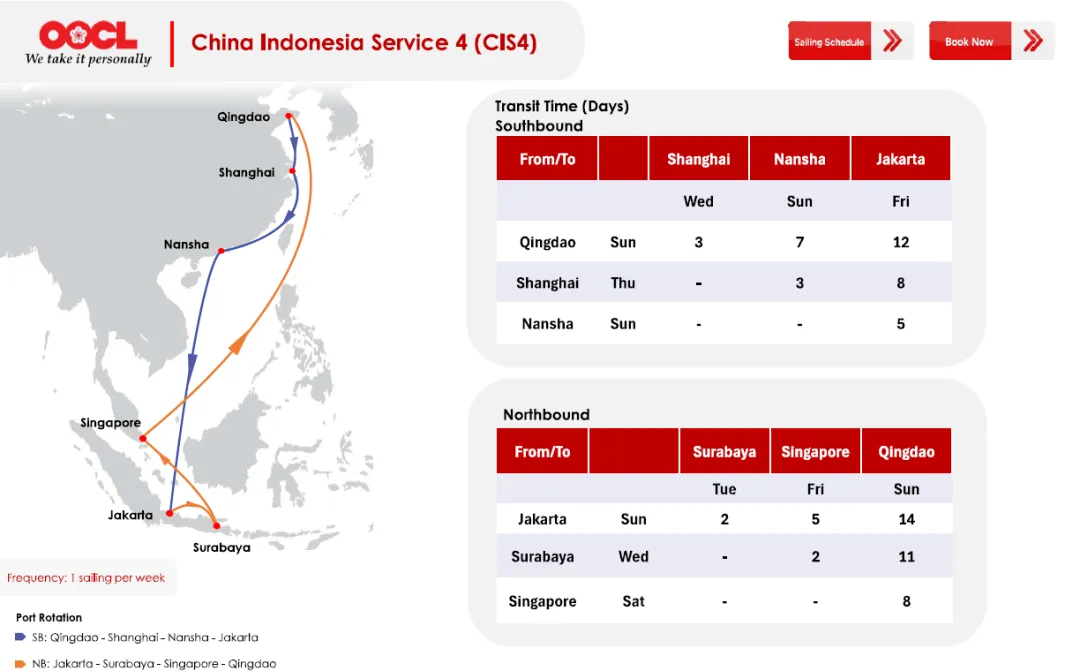
The China-Indonesia CIS4 route (Qingdao - Shanghai - Nansha - Jakarta - Surabaya - Singapore - Qingdao), which OOCL will launch on November 22, will be added to the direct shipping network from North China to Singapore and Indonesia. The direct shipping network from North China to Singapore and Indonesia is becoming denser.
According to data from Drewry on November 10, the Asian intra-regional container freight rate index IACI was $1,478 per FEU, a slight decrease of $26 compared with the previous month, but overall it was still about 135% higher than a year ago. The Shanghai - Singapore rate increased by 9% to $2,064 per FEU, the Shanghai - Jakarta rate decreased by 8% to $2,538 per FEU, and the average waiting time for ships in Qingdao dropped from 35 hours to 23 hours. This indicates that "more routes and faster ports" have been achieved, but the regional freight rates remain high, and there is a significant differentiation among different destination ports.
Industry perspective
Drewry's analysis suggests that the demand resilience within Asia remains, and congestion at ports and weather disturbances will constrain effective capacity. New routes will temporarily alleviate capacity pressure, but the high freight rates will not quickly return to pre-pandemic levels. Industry insiders also note: The value of the direct shipping route from North China to Southeast Asia does not lie in "saving a few hundred US dollars per TEU", but in "predictable shipping schedules, fewer transfer nodes, and quick abnormal communication".
II. Import regulations have changed, and Thailand has tightened its container booking procedures.
Around November 11th, Hapag-Lloyd released a customer notice on its local business page: Due to the recent changes in the regulatory requirements for the import and disposal of metal and rubber waste in Thailand, we are suspending the acceptance of new bookings for some waste shipments destined for Thailand from now on. The resumption date will be announced later.
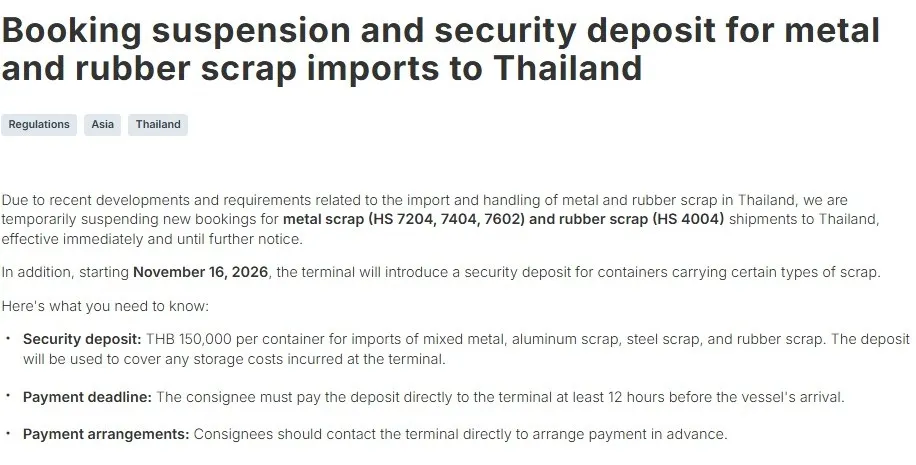
This notice pertains to four tax codes:
HS 7204: Scrap steel waste
HS 7404: Scrap copper waste
HS 7602: Scrap aluminum waste
HS 4004: Scrap rubber waste
This is not a routine reminder of "weight limit and product name restrictions", but rather the shipping company has closed the booking slots earlier before the port supervision is fully implemented: new orders are not accepted, and for the in-transit orders, each shipment is closely monitored at the port of destination. More importantly, Hapag-Lloyd's announcement clearly states: starting from November 16, 2026, the relevant terminals in Thailand will charge a deposit of 150,000 Thai Baht (THB) per container for imported mixed metals, aluminum waste, steel waste, and rubber waste, to cover the possible container storage fees. This fee is not a shipping cost or a company surcharge; it is directly paid by the consignee to the terminal.
The payment schedule has been blocked: The consignee must complete the payment at least 12 hours before the vessel arrives at the port and contact the terminal in advance to confirm the payment path; if the terminal does not receive the deposit before the deadline, the container will remain on the ship and will not be unloaded, and the reverse container movement, relocation, demurrage, and operation fees incurred will be recovered by the terminal/Hapag-Lloyd from the responsible party. The announcement does not uniformly list the applicable terminal list; it is necessary to confirm each shipment with the shipping company or the actual unloading terminal.
This rule should be read in two layers:
① Customers of scrap materials are directly affected. Those exporting scrap steel, copper, aluminum, and rubber to Thailand can no longer book new shipments through the normal path of Hapag-Lloyd; for the already booked and in-transit goods, the Thai consignees should immediately contact the terminal to lock the payment process and don't wait until the ship reaches the anchorage to make up the payment.
② General cargo that is not scrap materials is a compliance warning. The Thai customs has recently tightened the inspection of scrap materials, HS classification ambiguities, and electronic waste disguised as ordinary metal products. Construction materials, mechanical parts, second-hand equipment, and goods containing rubber parts, before booking the shipment, should carefully check the HS code, material description, and import permit for the destination port to avoid being detained by the destination port due to "mismatched goods".
Media and institutional background shows: The Thai Customs Department suggested in late October to list four types of scrap materials as prohibited imports, and the Foreign Trade Department simultaneously sent a letter to the Pollution Control Department to study changing the licensing system; the proposed direction is a 6-12 month transition period, only allowing factories with their own smelting/recycling lines to import with inspection certificates, and the import volume should not exceed actual production capacity. As of mid-November, the government's formal ban and effective date have not been fully implemented yet, but shipping companies have taken precautions in advance due to "increasing regulatory strictness".
Industry opinion
Shipping compliance and port operation experts suggest: Hapag-Lloyd is not raising prices alone this time, but isolating the "uncertain costs at the port of destination" in advance. Scrap material supervision is a long-term trend in Southeast Asia - Thailand, Vietnam, and Malaysia have been moving environmental protection, impurities, and electronic waste identification forward to the booking and terminal stages for nearly a year.
The expert points out: The 150,000 Thai Baht per container deposit mechanism is essentially transferring the risk of container storage and detention from the shipping company to the consignee. If the HS code, purpose, and consignee's qualification are not clarified in the booking process, it will backfire on domestic allocation, re-export, and customer complaints.
III. Direct voyage to the Red Sea, returning to Qingdao
On the 12th, the China - Red Sea OGRD shipping route of Evergreen Shipping was officially resumed. The first voyage vessel "Ever Superb" (7024 TEU) set off from Qingdao and operated on a biweekly schedule. Initially, 4 ships of 7,000 to 9,000 TEU capacity were deployed, with a total turnaround time of approximately 56 days. At the same time, on November 8th, the Ever Eon vessel of Evergreen passed through the Suez Canal. It was the first vessel of Evergreen to pass through the Suez Canal since January 2024, marking the return of the main members of the Ocean Alliance.

The significance of this line is straightforward: In the past three years, most goods transported from China to the Red Sea coast had to be transshipped in Singapore or Jeddah. There were additional handling procedures, more transit time, and an increased probability of cargo damage. With the resumption of direct routes, the transportation chain from Qingdao to Jeddah, Suheina, and Aqaba has been shortened. For goods with tight delivery deadlines such as building materials, steel, mechanical parts, and daily necessities, this means that the "direct shipping time" and "transshipment cost" can be compared again.
However, the resumption of the routes is not a risk-free promise. Shipping companies such as Evergreen and ONE still retain safety fallback clauses: If the situation in the Red Sea fluctuates, the voyage may still be temporarily redirected. Therefore, for shipments made in late November and December, one should not only consider "passing through the Suez Canal", but also confirm the "actual voyage route + vessel tracking" twice.
Industry perspective
Simon Heaney, Senior Manager of Container Research at Drewry, pointed out that the return of carriers to the Suez Canal is the result of both operational efficiency and competitive pressure, rather than just fuel savings. The shipping consulting agency Linerlytica concluded that the major alliances are expected to fully restore canal passage in the first quarter of 2027.
Source of information: Shanghai Shipping Exchange, Drewry, Xeneta,新浪财经, People's Daily Online, Jiangsu Maritime Administration, Hapag-Lloyd official website announcement, Logistics Bar, Shipping Network, Alarun, etc.
The Boxster International official account is only used for the dissemination and sharing of industry information and does not constitute the ship company's quotations, route commitments, insurance suggestions or legal opinions. The sailing dates, additional charges, call ports, available goods categories and safety conditions may all be adjusted by the carrier after booking the shipment. Please refer to the latest customer notifications from the shipowner, on-site port rules and actual booking confirmation. This article is for reference only. If there is any infringement, please contact us and we will verify it immediately and delete it.
copyright © Qingdao Bodon International Freight Forwarding Co., Ltd
Online
Service
Online Serviceservice time : 9:00-17:00

telephone
+86-0532-82821788
Qingdao Head Office

 中文
 English