I. The rents for Asian feeder routes have risen and the lease terms have been extended.
Projects worth trillions of dollars such as the Vietnam North-South High-Speed Railway and Intermodal and Cross-border Railways have been approved one after another. The expansion of short-haul capacity at the Cambodian ports in Southeast Asia is no longer just a matter of price; in addition to having "goods", it is also necessary to seize the right vessels and ensure the punctuality rate.
The Intermodal Weekly Report released on November 1st shows that the daily charter rate for a 1700 TEU container ship with a 6-12 month lease term is approximately $33,750, a 19% increase from the previous year and more than doubling the level in 2023. The rate for a 1000 TEU vessel is approximately $18,750, a 10% increase, and the average lease term has extended to approximately 24 months. Based on the same data, it is expected that the container trade volume within Asia will reach 72 million TEU in 2026, an increase of 5.4%. The average spot freight from Shanghai to Southeast Asia in October was approximately $1,154 per TEU, about 2.5 times the average in 2025.
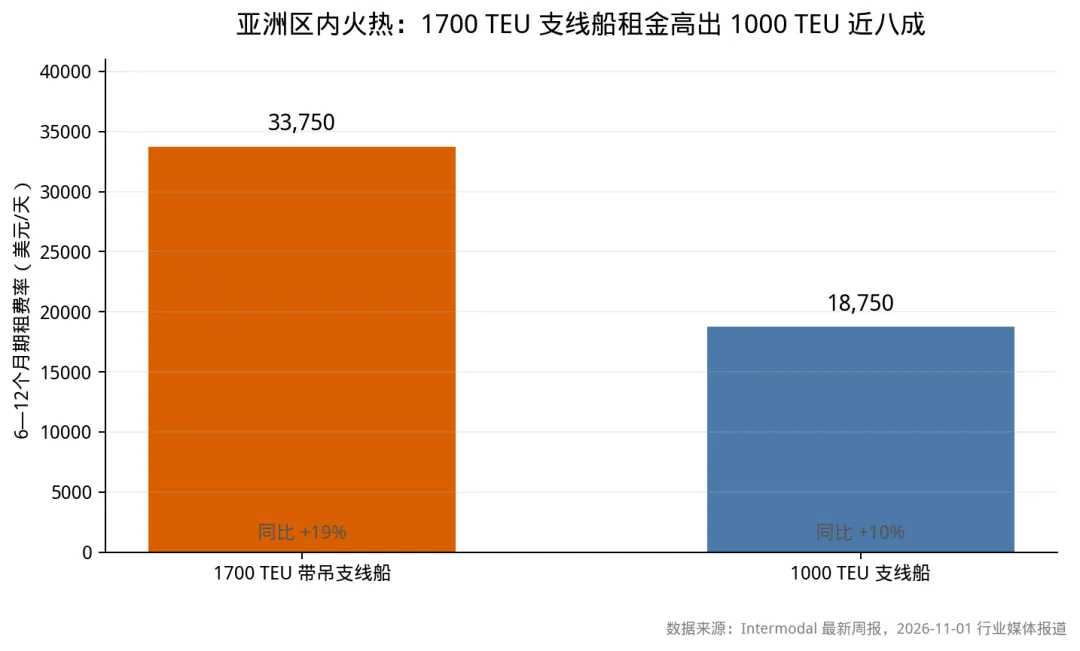
These are market analyses by brokerage firms regarding rents, trade volume and freight rates, not the quotations of shipping companies or the transaction prices in Tianjin or Qingdao; but they explain the perception of a customer: The short-haul routes in Southeast Asia may seem to have short voyages, but they are highly dependent on small container ships with cranes, regional barges and dense port calls. When the shipowners are willing to lock in the feeder capacity with a two-year long-term contract, it indicates that the market judgment is not that "the peak season lasts only a few days", but that the cargo flow, port calls and transshipment demands within Asia will continue to consume the available capacity.
The daily charter rate for a 1700 TEU container ship with a 6-12 month lease term is approximately $33,750, which is 80% higher than that of a 1000 TEU vessel at $18,750.
For exporters in Tianjin and Qingdao, the planning of orders from Southeast Asia should shift from "whether there are containers at the end of the month" to "whether there are stable shipping schedules in the next four weeks". For containerized cargo, attention should be paid to the docking and unloading rhythms, oversized items should be confirmed with the lifting equipment and deck positions, and cold storage containers should be confirmed for power supply positions and temperature control at the transshipment ports; comparing only the per TEU maritime freight is likely to overlook the hidden costs caused by dumping containers, reconfiguration and waiting. On the other hand, do not mistake $1,154 per TEU as the export quotation for North China, as the Shanghai pricing, container type, surcharges and transaction discounts are all different.
Industry perspective
The increase in feeder ship rents and the extension of the average lease term usually mean that the shipowners are more afraid of missing future capacity rather than just wanting to raise prices temporarily. If the manufacturing and transshipment cargo flow in Southeast Asia continues to outperform the return cargo flow on the main lines, the "premium for schedule stability" in the North China - Singapore and Indonesia directions may be more crucial than the base price itself. Conversely, if the delivery of new ships in 2027 is faster than the growth in cargo volume, both the rent and the spot price may fall from their highs; this is an industry forecast, not a current promised reduction in prices.
II. The risk in the Persian Gulf remains high, and pay attention to the Middle East route.
The daily charter rate for oil tankers has reached an extreme high. Note: Container cargo will not automatically "copy the oil tanker price", but the route and delivery time must be recalculated.
The industry report released on October 27th quoted the oil tanker consulting firm Poten & Partners' estimate: The benchmark voyage charter rate (TCE) for ultra-large crude carriers (VLCC) on the Persian Gulf - Asia route once reached a historical high of $140,000 per day; the proportion of freight in the cost of crude oil at the destination was increased from about 3% before the war to about 27%. This is not a container freight rate and cannot be directly applied to 20-foot or 40-foot containers; it measures the extreme premium for effective tanker capacity, insurance and route rearrangement in high-risk sea areas.
For container cargo owners in the Middle East, the signal is in three transmission chains. First, the shipowners will continue to split the risks of high-risk areas, such as capacity, fuel and insurance costs, into different surcharges, and the validity period of the quotations may be shortened. Second, detours, waiting and temporary port changes will cause a greater gap between "sea voyages" and "total delivery days", and customers cannot only produce based on the baseline voyage. Thirdly, even if a certain shipment does not enter the Persian Gulf, as long as it shares the network with the affected vessel, container source, or transit pool, it may still be subject to indirect fluctuations.
However, this does not mean that all Middle Eastern cargo must be suspended. Nor should "war risk premium increase" be written as a fixed amount that increases for every shipment. The public materials do not disclose the uniform war risk premium rate for goods departing from Tianjin or Qingdao by container ship. This article does not provide additional figures. A more prudent approach is to request the applicable cost list for each shipment by destination port, whether it is a transit through the Strait of Hormuz or a transfer, the shipowner, and the booking date, and include the responsibility boundary of "re-routing, detour, delay, and additional costs" in the confirmation of the commission.
Industry perspective
The hull types, cargo value, insurance structure, and flexibility of detour of oil tankers and container ships are different. $140,000 per day should not be misinterpreted as the cost of container ships. However, both share the same set of risk expectations: as long as the effective capacity in high-risk areas is occupied, the cost will spread throughout the network. Therefore, the buffer for Middle Eastern orders should not only be added to the shipping cost budget but also to the delivery time, inventory preparation, and safety stock; for non-interruptible production lines, a dual-port, dual-shipowner plan is more stable than betting on the "fastest route".
III. CMA CGM Africa PSS North China Billing Window
Africa is not a unified price zone. Do not calculate based on the quotation date. October 28th is a cost division line for the Tianjin-Durban orders.
Recently, the publicly disclosed PSS arrangement for the peak season in the CMA CGM Africa direction placed "origin area + destination port + billing rule" on the table for the cargo owner. The public statement is as follows:
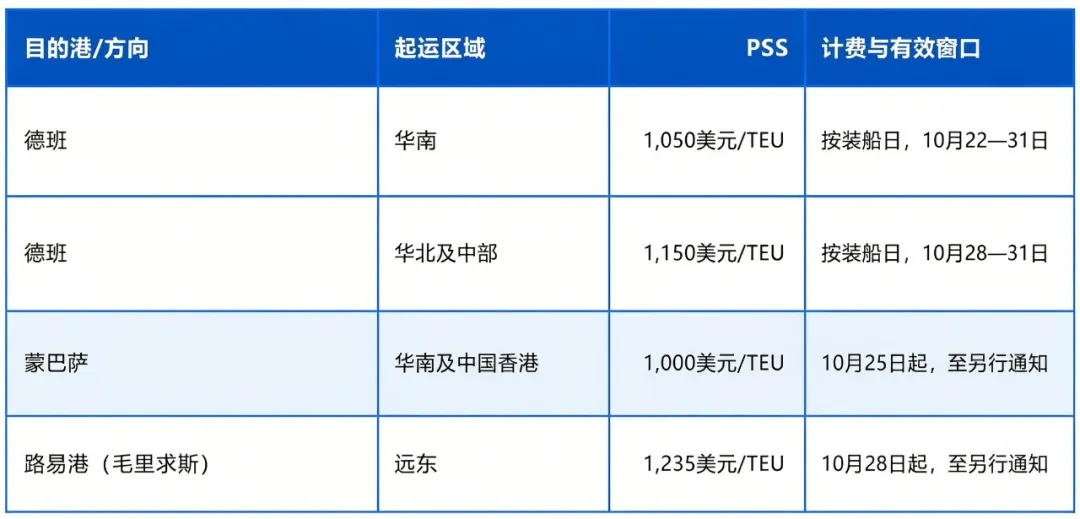 The current public standard is $1,000 - $1,235 per TEU, applicable to all goods in relevant directions; for Durban, it is judged based on the loading date, while for Mombasa and Port Louis, it is implemented from the effective date until further notice. For the Durban cargo departing from Tianjin or Qingdao, the most critical point is the billing division line on October 28th: orders that have confirmed the shipping cost but have not yet locked the loading date cannot continue to use the old PSS template; even if the shipping company accepts the booking, as long as the actual loading falls into the new window, the additional fee may still be charged according to the new standard.
Note: PSS is an additional fee for shipping costs and does not automatically equal the final arrival cost. Whether the port terminal charges, handling, detention of containers and ships, transfer of ships, war risk additional fee, and local taxes are included must be confirmed on a case-by-case basis. Presenting a quote of $1,150 per TEU as "the shipping cost has increased by $1,150" is likely to cause both the sales contract and profit calculation to be distorted simultaneously.
Industry perspective
The rate in North China for Durban is higher than that in South China, and the billing starting point is set at October 28th, indicating that the shipowner is not mechanically changing prices for the entire African region, but is calibrating based on the port position, empty container return, and port turnover. If the operation at the destination port is slower than expected, the openness of the "until further notice" for PSS will be more worthy of attention than a single increase amount; conversely, if the port turnover at Durban improves, it may be adjusted first with the additional fee rather than directly lowering the base price.
IV. Red Sea Re-opening Trial, Currently "Two Lines"
The Suez Channel is starting to test, not a full re-opening, nor will the detour fee be immediately zeroed out. MS2 starts from Qingdao, but the safety retreat clause is still in effect.
On October 29th, industry media quoted ONE as announcing that the Premier Alliance (PA Alliance) under MD1 and MS2, two Asian-Mediterranean routes, will resume navigation through the Red Sea and the Suez Canal. The first voyage is planned to start in November. The disclosed arrangement
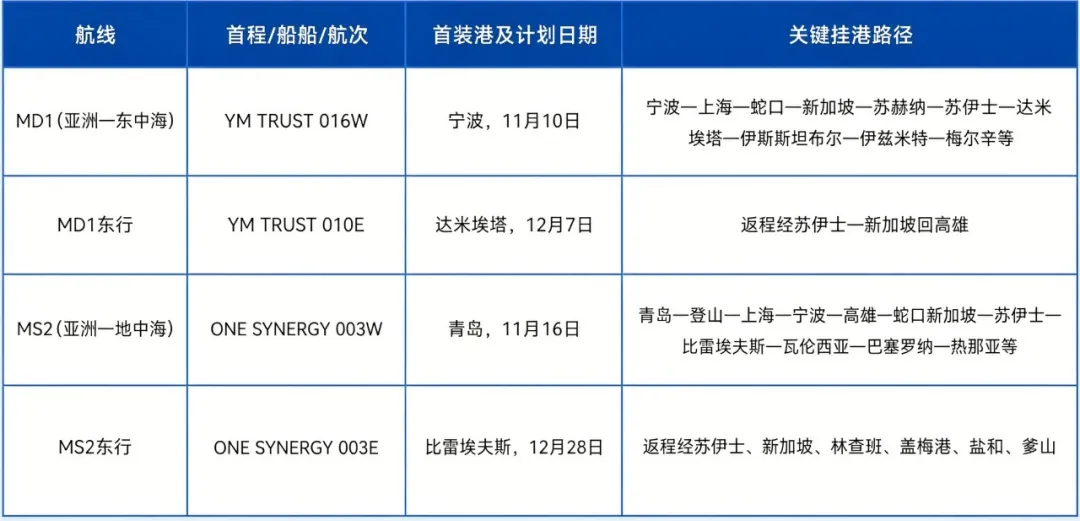 MD1 is executed by Yangming Shipping vessels, and MS2 is deployed by ONE and Yangming vessels in a mixed manner; the report clearly states that HMM does not participate in this round of re-opening. ONE's statement also retains the condition: re-opening is based on the assessment of the regional security situation, and will continue to monitor, and adjust the route if necessary.
For the cargo owners in Tianjin and Qingdao, this means that the first batch of actual benefiting shipping spaces will only become available in late November, rather than immediately enjoying the "Suez direct voyage" from October. MS2 loaded its cargo in Qingdao. If the actual implementation is stable, some of the cargo from North China to the Western Mediterranean may have the opportunity to reduce the transit time caused by detours; however, the first voyage still serves a verification function, and port changes, delays, and additional fee adjustments may occur. The Eastern Mediterranean and the Western Mediterranean cannot be confused: MD1 is biased towards the Eastern Mediterranean, while MS2 covers the West Mediterranean nodes such as Piraeus, Valencia, Barcelona, and Genoa.
Industry perspective
The resumption of the two lines is more like a "controlled trial run", not a comprehensive signal from the market that the risks in the Red Sea have been completely eliminated. The shipowners retain the right to retreat, indicating that the route design still relies on safety assessment and insurance conditions as the valves. For orders that are sensitive to delivery time, have high value, and can tolerate changes in the route, the formal quotation of MS2 and the detour plan can be compared; for contracts with rigid delivery dates and the need for precise commitment, temporarily, they should still be scheduled in a "possible recovery, possible adjustment" dual scenario, and it is not advisable to directly write the first voyage on November 16th into the customer's delivery date guarantee.
V. Capacity Enhancement, Qingdao Takes on European Transshipment
The 2023 annual report of Qingdao Port shows a double growth in business performance. Qingdao's competitiveness is shifting from "having one more line" to "being able to complete transshipment faster". The congestion in foreign ports may not only lead to delays.
On October 29th, People's Daily published a report on the efficiency of Qingdao Port: Due to the congestion in some foreign ports, the Twin Stars Alliance AE10 European route transferred some goods that were originally destined for transshipment in foreign ports to Qingdao for transshipment. The report also provided two traceable data: since 2026, Qingdao Port has opened 16 new container routes; as of September, the Huangdao Border Inspection Station inspected and controlled 13,500 ships and 291,500 people entering and leaving (at the port) by sea. On-site measures include "one ship, one plan", pre-inspection, on-arrival inspection, and on-board personnel verification, etc.
For Qingdao's export enterprises, the correct interpretation of this news is not "all European goods should switch to Qingdao", but: When there is a queue at a certain point of the European main line, Qingdao has the practical ability to bring some of the transshipment actions back to domestic ports for execution. Its value lies in that the single document, abnormal communication, and subsequent re-hauling are easier to be connected with the domestic operation chain, reducing the time when goods are "invisible and unanswerable" at overseas nodes. For the Tianjin cargo sources, Qingdao can be regarded as a backup transshipment port, but it must first calculate the cross-port transportation of trailers, the ownership of customs declaration, the responsibility of re-loading, and the additional land transportation costs, to avoid shifting the costs to land transportation for the sake of a nominal speed.
This also explains why "port efficiency" is becoming part of the route product. The face-scanning boarding of each person in the report is only a slice of the on-site process, and it cannot be extrapolated to the entire ship berthing, loading or transshipment efficiency; what really affects the delivery time is the pre-inspection, berth connection, yard turnover, and whether the subsequent loading and unloading are synchronized and accelerated. For time-sensitive contract orders, still track by voyage, and do not take the speed of a single point process as the port commitment.
Industry perspective
The return of overseas congestion to Qingdao for transshipment, in the short term, is the "replacement node" effect, and in the medium term, it will test Qingdao's storage and re-hauling flexibility. If the inbound cargo volume continues to increase, while the railway, cross-port transportation, cold chain power supply capacity, and hazardous materials isolation capacity are simultaneously under pressure, the efficiency advantage may shift from the border inspection stage to the storage stage.
Source of information: People's Daily, Sina Finance (reprinting shipping information), China Petroleum News (reprinted by Sina Finance), The Most Shipping (an industry media, citing ONE's announcement), Shipping Planet Tech (reprinted by NetEase). Media speculations are separately marked. The shipping schedules and surcharges are subject to the official customer notifications of the shipping companies.
The Boxster International official account is only used for industry information dissemination and sharing. Data and policies are based on official announcements, shipping company notifications, exchange indices, and real-time port updates. This article is only for shippers' decision-making reference and does not constitute a price lock commitment. If there is any infringement, please contact us, and we will verify and delete it immediately.



 中文
 English