1. Taiping strengthens its presence, with new upgrades in Indonesia and Malaysia
PIL officially announced its intra-Asia route adjustment plan on September 24, with its maiden voyage directly connecting Qingdao and Tianjin. This move continued to gain momentum in mid-October, becoming a focal point for northern export enterprises. According to the announcement, two core routes will undergo significant upgrades:
① The NCI North China-Indonesia route is scheduled to make its maiden voyage from Qingdao on November 8, 2026, fully covering China, Indonesia, and Singapore, with enhanced cold chain cargo transport capabilities;
② The China-Singapore-Malaysia route, set to debut from Tianjin on October 27, 2026, will connect northern and southern Chinese ports with the western gateway ports of Singapore and Malaysia, with Singapore serving as the core transit hub.
Major international shipping companies have chosen Qingdao and Tianjin for the inaugural ceremonies of key routes, sending a clear signal that the value of cargo flows from northern ports to Southeast Asia is being reassessed and enhanced. The addition of new routes by PIL means that shipments of frozen goods to Indonesia, transshipment cargo to Singapore and Malaysia, as well as cargo destined for third countries via Singapore, will have more direct sailing options and transit combinations. However, it should be noted that the "initial sailing date" announced by shipping companies is not fixed.太平船务 explicitly warned that the first sailing date may be adjusted based on operational conditions, and the actual ports of call, cut-off times, and cabin space availability must be confirmed according to the final schedule.
Industry Perspectives
The Asia Regional Route Product Manager analyzed that the addition of PIL's routes is good news, but further attention is needed—such as the original transit time from COSCO/ONE/Wan Hai to Jakarta, the current direct sailing time from PIL Qingdao, the price difference for transshipment from Singapore to Klang/Tanjung Pelepas, and whether the power supply for refrigerated containers has been reserved.
2. Asian Games prices fluctuate at high levels, with limited cabin space available
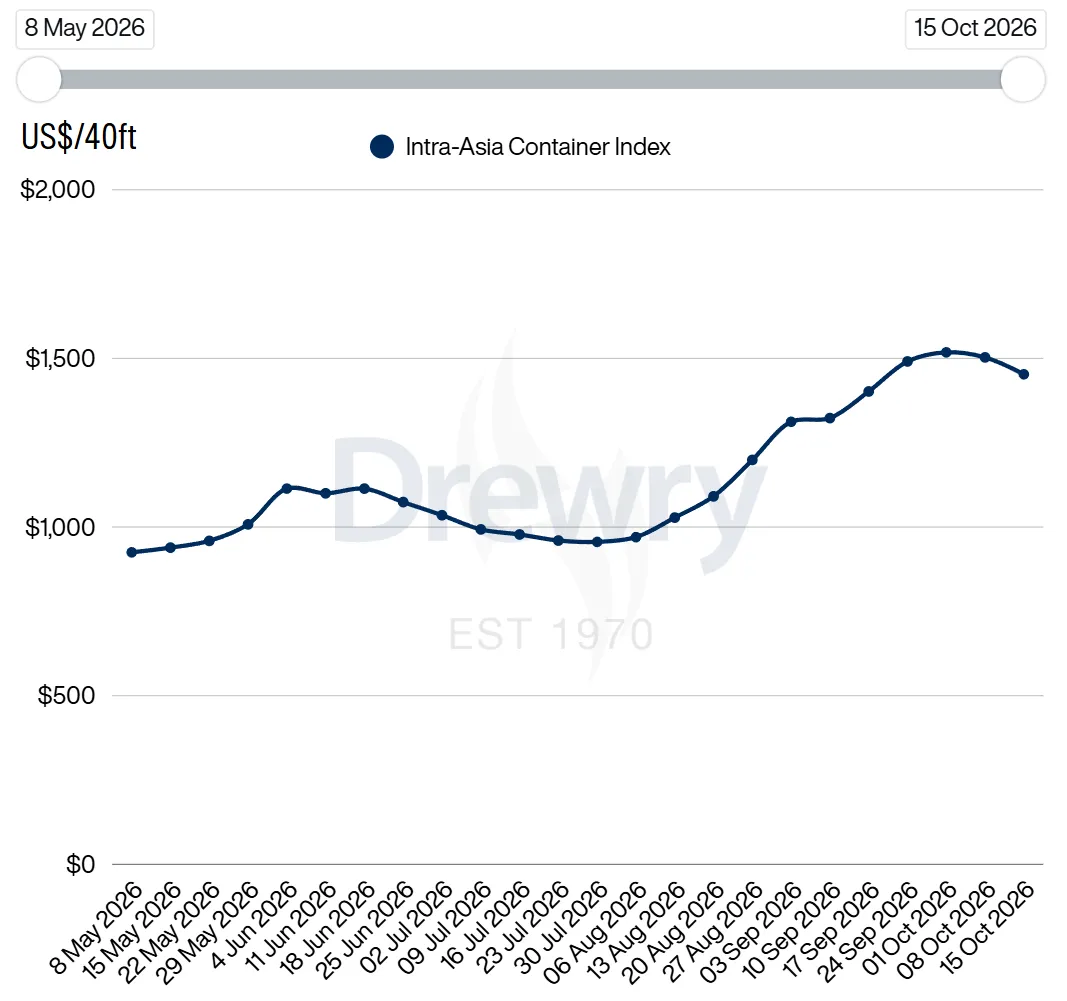
Recently, Drewry's intra-Asia container index showed that spot freight rates within Asia experienced a slight decline for the first time after six consecutive weeks of upward movement. However, beneath the surface of short-term fluctuations, the year-on-year data remains staggering—a surge of 209% compared to the same period last year.
The core rationale supporting the maintenance of historically high freight rates remains unchanged: persistent congestion at major Southeast Asian ports, extended vessel waiting times, and some shipowners shifting capacity to major routes like trans-Pacific to chase higher profits, resulting in a structural shortage of intra-Asian loop capacity.
Meanwhile, amid the wave of regional industrial relocation, the volume of trade in components, semi-finished products, packaging materials, building materials, and mechanical spare parts between China and ASEAN remains exceptionally stable, with a clear underpinning effect driven by essential demand.
Shippers exporting to Southeast Asia should not be misled by short-term data showing "slight declines." The current market is not a "buyer's market," and the era of "low-cost, easy shipments" on near-sea routes has ended. Taking the Qingdao to Indonesia (Jakarta, Surabaya, Medan) route as an example, demand for NCI-class services for refrigerated containers and breakbulk cargo remains strong. In the Tianjin to Singapore, Klang, and Penang transit hubs, cargo volumes are full, while second-leg shipping schedules are becoming more volatile. In Vietnam, Hai Phong and Ho Chi Minh ports have seen a surge in inquiries for refrigerated containers and small chemical containers due to concentrated factory raw material replenishments post-holidays. Meanwhile, Thailand's Laem Chabang and Lae Kha Bang ports maintain high export levels for automotive parts and rubber machinery.
Industry perspective
A senior Southeast Asian airline freight forwarder pointed out that a year-on-year increase of 209% declared the end of the era of "cheap overseas logistics". Currently, more emphasis should be placed on: the ability to obtain cabin space, the ability to operate special containers, and the ability to comply with documentation.
3、 More than half of the Red Sea has resumed operations, and positive news is gradually emerging for Europe and Europe
On October 16th, the industry authoritative platform "Most Shipping" disclosed that the EVER YON vessel (voyage 0826-003E) operated by Evergreen Marine, a subsidiary of the Ocean Alliance, plans to sail through the Suez Canal/Red Sea for the first time on the eastbound return section of the CES route on November 4th, and is expected to arrive in Shanghai on December 5th. This marks the official entry into the operational phase of the recovery trial voyage of the Red Sea/Suez Passage.
More macro level data comes from BIMCO and Clarkson: On October 14th, BIMCO confirmed that the container shipping capacity of the Suez Canal has been restored to over 50% of the pre Red Sea crisis level in November 2023; In the first two weeks of October, the average weekly capacity of container ships passing through Suez reached 753000 TEUs, compared to approximately 1.4 million TEUs during the same period before the crisis. Since early July, global shipping companies have diverted 16 routes from Cape of Good Hope to the Suez Canal. In the third quarter, Suez's northbound transport capacity was only 75% of its southbound capacity, but it had climbed to 81% in the first two weeks of October.
On October 19th, Sina Finance reported that shipping companies such as Evergreen and Yangming plan to restart the Red Sea route in November after a three-year hiatus. The resumption range is expanding from Asia Mediterranean East to Asia Europe West Main Line. The direct benefit of resuming operations in the Red Sea is a significant reduction in the distance between Europe and Japan, as well as an easing of fuel costs and container turnover pressure for circumnavigation. However, the risks during the transition period cannot be ignored: a large number of ships may flock to port, and European hub ports such as Rotterdam and Antwerp may face short-term congestion; The supply of cabin space in the Red Sea region (Jeddah, Aqaba, Suhena) and Egypt, Sudan, Djibouti will increase, but the shipping schedule may still be subject to repeated adjustments.
Industry perspective
Red Sea route analysts believe that resuming flights does not mean an immediate "halving" of freight rates. During the transition phase, shipping companies are likely to retain safety surcharges and war risk premiums until both southbound and northbound routes operate stably. At present, a dual track strategy should be adopted: Red Sea orders should not only target a single shipowner, but also reserve two sets of delivery plans: the "bypass version" and the "Suez version"; For customers at destination ports such as Jeddah and Suhena, a mechanism for sharing demurrage fees should be negotiated in advance, as both European second leg transshipment and the Red Sea branch line need to rearrange their shipping schedules.
4、 African miscellaneous projects open up, new path for engineering to go global
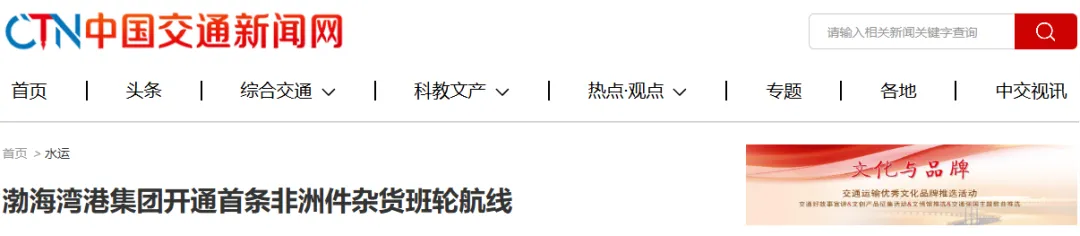
Recently, China Communications News reported an exciting news for the northern manufacturing industry: Bohai Bay Port Group's first African general cargo shipping route has officially opened. The maiden ship "Jinhaixin" docked at Weifang Port and loaded more than 20 types of cargo, including ton bags, engineering vehicles, and equipment, heading towards Africa.
This route adopts a "once a month" liner operation mode, supported by a "railway special train+automobile transportation" port logistics system, with cargo sources covering ton bag products from Shanxi, Hebei, and Tianjin, as well as engineering equipment from Jiangsu and Tianjin.
Currently, the infrastructure construction boom in Africa (South Africa, North Africa, West Africa, East Africa) continues unabated, with strong demand for the export of goods such as construction machinery, transformers, steel structures, mining parts, and agricultural machinery. These types of goods are often oversized and overweight, and containers cannot fit them. Customers also find it difficult to bear the long wait time for irregular bulk carriers.
The emergence of general cargo shipping has precisely filled the gap between "container" and "pure bulk shipping", providing fixed shipping schedules, professional binding, and a relatively transparent port fee structure. For engineering manufacturing enterprises around Qingdao and Tianjin, the successful sampling in Bohai Bay means that the organization and shipping of bulk cargo sources in the north are accelerating.
Industry perspective
The person in charge of the general cargo shipping route pointed out that the core advantage of the general cargo shipping line lies in "fixed shipping schedule+acceptable waiting time+professional binding of engineering cargo". It makes the schedule of funds predictable, but the disadvantage is also obvious - once a month, if missed, it will have to wait for another 30 days. It is recommended that exporters of construction machinery, building materials, and electrical equipment adopt a combination strategy: emergency goods are transported in transit containers or frame boxes, while regular goods are planned in advance for miscellaneous shipping.
5、 Frozen product inspection landing, food compliance first
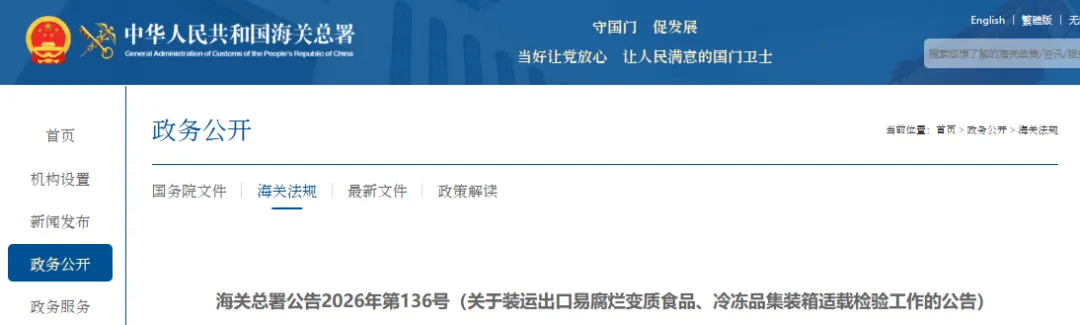
Announcement No. 136 of the General Administration of Customs in 2026 (issued on September 8 and officially implemented on October 1) has become the compliance red line with the highest number of inquiries from shippers this week. The announcement clearly stipulates that containers for exporting perishable food and frozen products must submit an application through the "China International Trade Single Window - Outbound Container Load Capacity Inspection Module" and upload the "Declaration of Conformity for Export Container Load Capacity" before shipment. Customs will conduct audits and spot checks depending on the situation. Only after passing the inspection can the shipment be approved. It is worth noting that the validity period of the load test results is only 21 days; In the export declaration process, the system will automatically verify the result, and if it does not pass, the order will be returned directly.
Qingdao (seafood, frozen vegetables, seasonings, pre made dishes) and Tianjin (frozen products, grain and oil, fruits and vegetables, canned food), as the most important food export bases in northern China, are the first to bear the brunt. After the implementation of the new regulations, the following minefields have frequently triggered shipping crises: unclean interior of containers, residual stains on loaded goods leading to unqualified spot checks; The refrigeration records of the freezer are missing, and the door seal is aging, resulting in a mismatch between the load declaration and the actual situation; The packing unit did not declare in advance, and only found out after the trailer arrived at the port that there was no result sheet, ultimately facing a chain reaction of return, container dumping, and even changing the shipping schedule.
Industry perspective
The senior customs affairs consultant emphasized that Announcement No. 136 will upgrade the responsibility of "suitability" from verbal promises in the past to system hard constraints - if a single window has no valid results, the customs declaration will be returned. Three key actions: Firstly, in the booking confirmation stage, it is clearly marked that "frozen/perishable food requires load capacity inspection results"; Secondly, establish a whitelist and intervene in box inspection in advance to ensure that the condition of the boxes meets the standards; Thirdly, it is essential to prominently display the 21 day validity period and strictly prohibit the use of expired inspection results to cope with new shipping schedules.
Information sources: Xinhua News Agency, Singapore Maritime and Port Authority (MPA), CCTV Finance, Bloomberg, The Loadstar, BIMCO (Baltic International Chamber of Shipping), Clarkson Research, China Shipping, Sina Finance, Drewry, Shipping News, China Traffic News Network, and the General Administration of Customs of the People's Republic of China.
The Boxster International official account only serves to disseminate industry information and share data. The data and policies are based on official announcements, shipping company notifications, exchange indices, and real-time port updates. This article is only for the reference of cargo owners and does not constitute a price lock commitment. If there is any infringement, please contact us, and we will verify and delete it immediately.



 中文
 English