According to a statement from the Houthi rebels, as reported by Xinhuanet, 73 international vessels passed through the Mandeb Strait from September 10th to 11th. The volume of traffic was equivalent to 98.6% of the daily traffic volume before the Houthi imposed a ban on Saudi vessels on July 20th; however, Saudi vessels were still excluded.
It should be noted that this data comes from a statement from one of the conflicting parties and is not yet a complete and auditable statistical report from an independent maritime authority. The exclusion of Saudi vessels also indicates that the navigation rules are still constrained by political and security boundaries. The stability of commercial shipping operations also depends on factors such as the shipowner's safety assessment, war insurance coverage, lease agreement arrangements, crew safety, the recommendations of the flag state, and specific voyage instructions.
CCTV News quoted the Joint Maritime Information Center on September 10th as reporting that the threat level in the Strait of Hormuz remained "severe", while in the Gulf of Aden and the Mandeb Strait - the southern part of the Red Sea - it was "moderate". It also warned that commercial ships should pay attention to military activities, electronic navigation interference, and temporary navigation instructions.
For export customers targeting the Middle East, East Africa, the Mediterranean, and the markets extending through the Suez Canal, a more likely scenario in the future will be a combination of "local navigation and local detours". The same destination port may have direct navigation, detour, sea-rail combined transportation, or transfer options; similar schemes may also vary in cost and timeliness due to differences in shipowners, flags, insurance, and war risk surcharges.

According to Xinhua News Agency, the UAE stated that in response to the obstruction of passage through the Strait of Hormuz, it has initiated multiple alternative logistics channels connecting the Arabian Gulf, the Red Sea and the Gulf of Oman, and has cooperated with Oman to transfer goods through ports such as Sohar and Dukhum. The UAE is also promoting the construction of ports on its eastern coast such as Al Houfikhan, Fuqairah and Dibaa, as well as the operation of energy pipelines.
This indicates that the regional supply chain is shifting from "reliance on a single strait" to "a combination of ports, land routes, pipelines and transfer networks". For the export supply chains of India, Pakistan, the Middle East, East Africa and China, the strategic value of alternative routes lies in increasing redundancy: when a certain entry or shipping segment is restricted, delivery can be maintained through port changes, barge transportation, land transportation or multimodal transportation.
However, "policy initiation" does not mean "every shipment becomes available immediately". The maturity of alternative routes depends on the unloading capacity of ports, the presence of liner services, the frequency of barge transportation, bonded transfer, customs procedures, land transportation costs and the distribution capacity of the destination port. Standard containers, general cargo, project goods, energy and chemical products differ significantly in terms of handling equipment, hazardous material regulations, transfer requirements and cost structure.

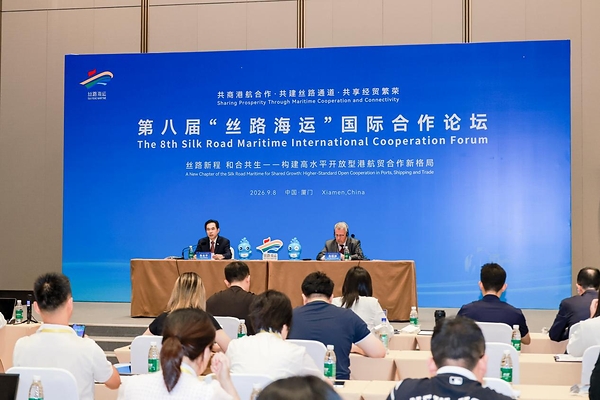
According to the China Transportation News Network, the 8th "Silk Road Shipping" International Cooperation Forum opened in Xiamen. Representatives from 19 countries and regions, including 1,800 people from the fields of ports, shipping, logistics, trade, finance, and technology, attended the event.
The forum announced the launch of the "Silk Road Shipping" Arctic route meteorological navigation service. It will establish an Arctic sea ice observation network based on Fengyun meteorological satellites, integrate numerical forecasting and AI algorithms, and provide daily sea ice forecasts for the next 15 days and dynamic monitoring of polar cyclones. At the same time, the Xiang-Min "Silk Road Shipping" sea-rail intermodal transportation channel was launched, claiming to save 20% - 30% of logistics costs and reduce the delivery time by 5 - 7 days. Twelve new "Silk Road Shipping" routes were launched on site.
This information reflects that supply chain competition is shifting from "single port competition" to "channel combination competition". However, the 20% - 30% cost savings and the 5 - 7-day time reduction still need to be verified based on actual cargo volume, origin and destination points, unloading efficiency, railway plans, validity period of freight rates, and customs clearance conditions at the destination port. The Arctic navigation service is a tool for risk assessment of high-latitude navigation and does not represent that the Arctic route has generally resumed or adapted to all cargo types.
For goods exported to Central China and South China, the Xiang-Min sea-rail intermodal transportation has the potential to reduce some land or transfer links, but the final competitiveness still depends on the end-to-end execution efficiency.
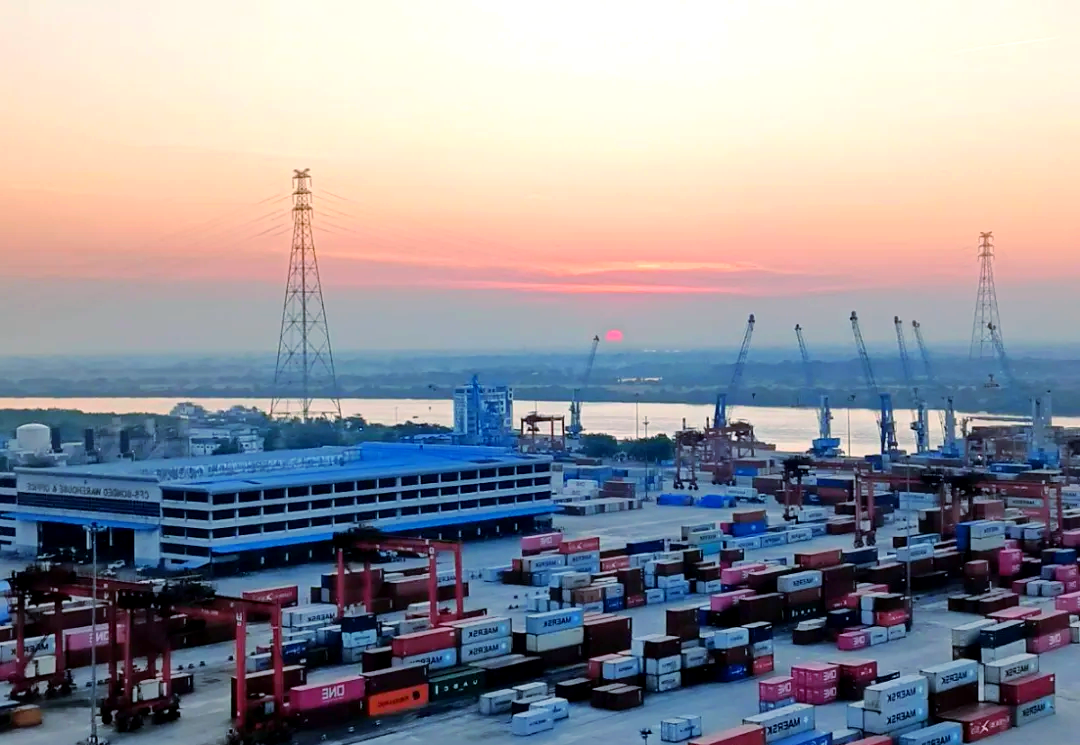
According to information provided by the Myanmar Port Authority and the Myanmar Global New Light Daily, from January to August 2026, Yangon Port received 457 container ships. In August, it handled 55 ships, and it planned for 61 ships to arrive in September. In 2025, the total number of ships handled was 728, which was higher than 633 in 2024 and 629 in 2023. Yangon Port handled over 90% of the regular imports and exports in Myanmar.
The data on arrivals indicate that Yangon Port remains an important node in the supply chain of the Bay of Bengal - Southeast Asia, having basic logistics significance for the export of agricultural products, building materials, machinery, daily necessities, miscellaneous goods, and project cargo. Compared to 2023, the number increased by approximately 15.4% in 2025, indicating that the port has not withdrawn from the regional trade network.
However, port activity does not equal throughput, customs clearance efficiency, inland transportation reliability, or comprehensive security. Political situations, bank settlements, insurance availability, border ports, railway and road connections, storage yards, and customs arrangements can all be independent variables that affect delivery apart from port operations.
The weekly report of the Guangzhou Maritime Exchange of the Ministry of Transport's Pearl River Navigation Administration shows that the Pearl River Shipping Comprehensive Freight Index at Guangzhou Shipping Exchange closed at 896.94 points, up by 0.23 points compared to the previous period. As of September 1st, leading shipping companies such as Maersk, Hapag-Lloyd, and MSC have announced their sailing suspension plans for the period from the end of September to mid-October, covering major routes from Asia to North America and Europe.
During the same period, after the floods in Guangxi subsided and navigation conditions were restored, the freight rates on some inland river routes from Guangzhou to Guigang and others were reduced. This indicates that "the upward trend in freight rates" is not a unified direction for all markets and goods; regional, cargo type, and supply and demand conditions vary significantly.
The navigation notice of Jiangsu Maritime System on September 8th stated that the first set of ship locks at Nantong Jiuzhou Port would be closed for construction from 08:00 on September 8th to 17:00 on September 19th, while the second set of ship locks would remain operational. This matter does not directly determine global shipping prices, but it may affect the container loading, unloading, barge transportation, and inter-river and inter-sea transportation windows for export nodes such as Shanghai and Ningbo via the Yangtze River and inland waterways.
copyright © Qingdao Bodon International Freight Forwarding Co., Ltd
Online
Service
Online Serviceservice time : 9:00-17:00

telephone
+86-0532-82821788
Qingdao Head Office

 中文
中文 English